Monday, September 11, 2006
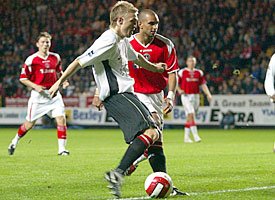
Giggs goal keeps United @ the top
Posted by Adrian Sobers
Wednesday, September 06, 2006
New DVD: Has Christianity Failed You?
On May 11, 2006, Ravi Zacharias and Michael Ramsden, before a sold-out audience at Atlanta’s renowned Fox Theatre, tackled the seeming failure of Christianity to respond with relevance and compassion in real-world experiences.
"That’s how it has failed us – when it becomes part of the judgment that divides us rather than the Grace that unites us."
Disc One replays that dramatic evening, with both messages, plus a 35 minute Q&A session in which some of the most difficult personal conflicts were voiced by earnest seekers. On Disc Two, Ravi and Michael continue to respond to those questions that could not be addressed during the evening because of time constraints; as well as other bonus features. This set is jam-packed with content!
Posted by Adrian Sobers
Tuesday, September 05, 2006
US population set to hit 300 million
Posted by Adrian Sobers
Solid Ground: September/October 2006
Posted by Adrian Sobers
Monday, September 04, 2006
Thursday, August 31, 2006
Google offers books for free
Posted by Adrian Sobers
Wednesday, August 30, 2006
Spurgeon sermon excerpts from: "Pricked in Their Heart"
Posted by Adrian Sobers
Tuesday, August 29, 2006
The compassion of Christ
• noun sympathetic pity and concern for the sufferings or misfortunes of others.
— ORIGIN Latin, from compati ‘suffer with’.
Christ was often “moved with compassion” before he helped others. The fact that this is often highlighted by the gospel writers is no accident. Before we can do a good deed, say a prayer or give sacrificially of our time or money, we like Christ, must be “moved with compassion.”
Think about that as you read and reflect on the following passages of Holy Writ:
Matthew 9:36 When he saw the crowds, he was deeply moved with compassion for them, because they were troubled and helpless, like sheep without a shepherd.
Posted by Adrian Sobers
The Greek and the Gospel
The sate of the Grecian is a sad one indeed. He believes all philosophy except the true one. He studies all wisdom except the true wisdom of God. He pursues all learning except spiritual learning. He likes everything which man makes and nothing which comes from God. The old, old Gospel is foolishness to him. Address just one doctrine in the Bible and he shuts his ears. He no longer wishes to keep your company. Declare God’s Truth to him: “Salvation is found in no one else, for there is no other name under heaven given to men by which we must be saved (Acts 4:12, NIV).” But he will have none of it. He will declare you a narrow-minded bigot and wish you a good morning.
The basic problem with the Grecian is that he is so full of himself, there is no room for Christ. The Father, Son and Holy Spirit wish to come and make “all things new”, but alas, “there was no room for them in the inn (Luke 2:7, NIV)” – Grecian is too full of himself. We should hold no enmity towards the Grecian, for he is to be pitied. You see, a day is coming when “all the nations of the earth will mourn”, for “They will see the Son of Man coming on the clouds of the sky, with power and great glory (Matthew 24:30, NIV).” Mr. Grecian, what will all your philosophy, learning and culture do for you then?
Posted by Adrian Sobers
Slice of Infinity: Taking Care of Treasure
Posted by Adrian Sobers
Monday, August 28, 2006
Truth about Islam lecture series
Why Islam today shuts down freedom of religion
The Islam section at Sermon Audio.com
Posted by Adrian Sobers
Tiger wins his fourth straight!
Woods survives playoff to win fourth straight tournament...
ESPN is also commemorating 10 years of Tiger Woods (as a professional golfer).
Posted by Adrian Sobers
Still @ the top of the table
Posted by Adrian Sobers
Friday, August 25, 2006
Thought for the Day
Posted by Adrian Sobers
Champions League Draw
Posted by Adrian Sobers
Thursday, August 24, 2006
What Does it Mean to Be Human?
Posted by Adrian Sobers
Spurgeon Gem: Christ Crucified
Posted by Adrian Sobers
United crush Addicks

Posted by Adrian Sobers
Wednesday, August 23, 2006
Excerpt from Praying Backwards
I purchased a copy of Praying Backwards last night and it's proving to be a pretty good read on the subject of prayer. Here is a brief excerpt from Chapter 2 (Praying in Jesus' Way):
"A letter attributed to a Civil War soldier expressed God's prayer priorities and the ultimate desires of the heart shaped by the Holy Spirit:
I asked God for strength, that I might achieve,
I was made weak, that I might humbly learn to obey.
I asked for health, that I might do greater things,
I was given infirmity, that I might do better things.
I asked for riches, that I might be happy,
I was given poverty, that I might be wise.
I asked for power, that I might have the praise of men,
I was given weakness, that I might feel the need of God.
I asked for all things, that I might enjoy life,
I was given life, that I might enjoy all things.
I got nothing that I asked for, but everything that I hoped for,
Almost despite myself, my unspoken prayers were answered.
I among all men am most richly blessed."
Posted by Adrian Sobers
What's lewd for you, isn't lewd for me...
I quote at lenghth, "To the best of my knowledge, public vulgarity of the type Sir John is concerned with is already illegal, however, no one has ever been prosecuted for the simple reason that there is no objective standard or proverbial line, which persons can be said to have crossed. Moreover, the development of such a definition would be an exercise in futility since there are many variations on such activity, which is clearly now the "norm" in society and for the benefit of those who are unconvinced, a norm is determined based on the typical behaviour of the masses within a particular context and in this context, lewd behaviour is the rule and not the exception (emphasis mine)."
The above is a correct true definition of a norm. But this is not the point. Because a behaviour is a norm, does not make it right or moral. If the masses behave crassly, they are still crass people. If the masses do a foolish thing, it is still a foolish thing.
With condemnation being branded as immoral; the writer then promptly goes on to condemn Sir John. WTH? It no longer surprises me that Bajans buy "new furnitures."
Posted by Adrian Sobers
Reflections on Truth
“Truth is not always popular but it is always right.” This quote from A Column to Cherish which appeared in the Sunday Sun really got me thinking about truth. But what is truth anyways? Truth is not solely an abstract philosophical concept therefore philosophy inevitably ends up defining truth too narrowly. Simply put, truth is that which corresponds to reality. True beliefs are those which portray reality as it is not as we hope, fear or wish it to be.
The biblical understanding of truth reflects fact that truth is multifaceted: theoretical, literal (Word of God) and personal (Jesus). For Christians, the God of Israel reveals himself not only in his Word but in his deeds. Truth is also expressed in the person of Christ in the New Testament. In his message and in his way of life. For the Christian, truth is not an abstract, “out there” concept. It is something that is inside us. It sanctifies us (John 17:17). It cleanses us. It does something to us.
The human mind has been deified in the Western world and, in the tradition of Kant, is viewed as the sole means of attaining truth. But the mind falls woefully short when it comes to the things of God. The mind has been marred because of the noetic effect of sin. Divine revelation is necessary; not only because of human depravity but because some things go beyond the capacity of reason (like the Trinitarian concept). Simply reasoning about faith therefore, cannot lead to tangible sign of those things (that are matters of faith). Revelation is also necessary.
“Truth is a daunting difficult thing, it is also the greatest thing in the world. We are chronically ambivalent towards it. We seek it and we fear it. Our better side wants to pursue truth wherever it leads. Our darker side balks when the truth leads us anywhere we do not want to go. We want both to serve truth and to be served by it. Such is our uneasy lot east of Eden.”
Posted by Adrian Sobers
Spurgeon Quotes from "War of Truth"
“We wrestle not with flesh and blood.” Christian men are not at war with any man that walks the earth. We are at war with infidelity but the persons of infidels we love and pray for. We are at warfare with any heresy but we have no enmity against heretics. We are opposed to and cry war to the knife with everything that opposes God and His Truth— but towards every man we would still endeavor to carry out the holy maxim, “Love your enemies, do good to them that hate you.” The Christian soldier has no gun and no sword, for he fights not with men. It is with “spiritual wickedness in high places” that he fights and with other principalities and powers than with those that sit on thrones and hold scepters in their hands. I have marked, however, that some Christian men—and it is a feeling to which all of us are prone—are very apt to make Christ’s war a war of flesh and blood instead of a war with wrong and spiritual wickedness."
"We are not fighting against men. We are fighting for men rather than against them. We are fighting for God and his Truth against error and against sin. But not against men. Woe, woe, to the Christian who forgets this sacred canon of warfare. Touch not the persons of men but smite their sin with a stout heart and with strong arm. Slay both the little ones and the great. Let nothing be spared that is against God and his Truth. But we have no war with the persons of poor mistaken men. Rome we hate even as we abhor Hell, yet for her votaries we ever pray."
But what have we behind them? What have we there, in the very vitals of our city? This city is a colossal culprit, it is a behemoth sinner and everywhere there are those who live in the vilest of vices and yet go unchecked and unreproved. We live in a time when it is unfashionable to tell men of their sins and there are few who have the spirit to speak out plainly of men’s sins. When we consider the mass of female profligates which number their committed by tens of thousands, are we not driven to conclude that the same sin must be rife enough with men?
Let us, then, Brothers and Sisters, each in our spheres, deal hard blows at the enemy. This is a fight in which all can do something who are the Lord’s people. Those who halt upon their crutches can use them for weapons of war as well as the mighty men can wield their swords! We have each an allotted work to do if we are the Lord’s elect. Let us take care that we do it. You are a tract distributor—go on with your work—do it earnestly. You are a Sunday-School teacher— go on, do not stop that blessed work—do it as unto God and not as unto man. You are a preacher—preach as God gives you ability, remembering that He requires of no man more than He has given to him. Therefore, be not discouraged if you have little success, still go on. Are you like Zebulon, one that can handle the pen? Handle it wisely. And you shall smite through the loins of kings. And if you can do but little, at least furnish the shot for others that you may help them in their works of faith and their labors of love. But let us all do something for Christ. I will never believe there is a Christian in the world who cannot do something. There is not a spider hanging on the king’s wall but has its errand. There is not a nettle that grows in the corner of the churchyard but has its purpose. There is not a single insect fluttering in the breeze but accomplishes some Divine decree.
Now this teaches that there must be prayer as well as effort. Minister! Preach on. But you shall have no success unless you pray. If you do not know how to wrestle with God on your knees you will find it hard work to wrestle with men on your feet in the pulpit. You may make efforts to do so but you shall not be successful unless you back up your efforts with prayer. You are not so likely to fail in your efforts as in your prayers. We never read that Joshua’s hand was weary with wielding the sword but Moses’ hand was weary with holding the rod. The more spiritual the duty, the more apt we are to tire of it. We could stand and preach all day but we could not pray all day. We could go forth to see the sick all day but we could not be in our closets all day one- half so easily. To spend a night with God in prayer would be far more difficult than to spend a night with man in preaching. Oh, take care, take care, Church of Christ, that you do not cease your prayers! Above all, I speak to my own much-loved Church, my own people. You have loved me and I have loved you and God has given us great success and blessed us. But, mark it well—I trace all of it to your prayers. You have assembled together in multitudes, perfectly unparalleled, to pray for me on each Monday evening and I know I am mentioned at your family altars as one who is very dear to your hearts. But I am afraid lest you should cease your prayers. Let the world say, “Down with him.” I will stand against them all if you will pray for me. But if you cease your prayers it is all up with me and all over with you. Your prayers make us mighty. The praying legion is the thundering legion.
Remember the great Intercessor—Christ is on the hill and while you are in the valley He pleads and must prevail. Therefore go on and conquer for Christ’s sake! I can no longer address you but must finish up by repeating the words with which I always like to conclude my sermons—“He that believes on the Lord Jesus and is baptized shall be saved and he that believes not shall be damned!” Oh that you would believe in Christ! Oh that God would give you faith to put your trust in Him! This is the only way of salvation. “Believe on the Lord Jesus and you shall be saved.”
Posted by Adrian Sobers
Tuesday, August 22, 2006
Introduction to Christian apologetics
Rick Wade's essay is a pretty good introduction to Christian Apologetics:
Posted by Adrian Sobers
Worthy to be written in gold
Posted by Adrian Sobers
Tim Challies book review: Praying Backwards
"Not too long ago I began to pray that God would teach me to pray. A bit of an odd request, is it not? Obviously I already knew something about prayer if I was praying about it in the first place, but my concern was that despite my prayer habits, which are sometimes good and sometimes bad, I have often felt that I just don't really understand what prayer is all about. When I pray I've often wondered just what the point is. I've often wished that I was better at praying and that maybe God would answer a few more of my prayers if I just learned to pray like a Spurgeon or another great preacher of days gone by whose words to God can still stir hearts even today. I believe God answered my prayer through Bryan Chapell and his book Praying Backwards..."I'll pick up a copy of this book in the very near future.
Posted by Adrian Sobers
Osama bin Laden lusts for...
Posted by Adrian Sobers
Monday, August 21, 2006
Blogger in Beta!
I've made the switch to the Blogger in Beta program. This is just a test post. Nothing much going on here ladies and gentlemen, move right along....show's over now....keep moving....
Posted by Adrian Sobers
Professional WordPress themes
Check out Template Monster if you are looking for quality WordPress themes.
Posted by Adrian Sobers
Live Strong, Lance Armstrong
Posted by Adrian Sobers
Good sports weekend!
The Yankees are one win away from sweeping the Red Sox after a great come from behind win in Boston.
And Tiger won the PGA Championship, pushing the total number of wins for him in the majors to a mind-boggling 12. Just six short of Jack (and he's only 30!). Goodness...
Posted by Adrian Sobers
Friday, August 18, 2006
On free will and the sovereignty of God
"The riddles of God are more satisfying than the solutions of man." Chesterton
There is a sign outside of Heaven which reads, “Whosoever will may come,” and once you enter in, you see the sign that says, “Chosen before the foundation of the world.” So understandably for some, free-will and the sovereignty of God are mutually exclusive.
If you were to ask the average person on the street what they understand by free-will, a great deal of them would probably tell you that it is the freedom to do whatever they want. But this is a ridiculous definition. It was Chesterton who said, “The freedom of your fist stops where my nose begins.” Freedom is relational. We do not exist in a vacuum, where our actions impact no one and we obey no rules. You and I cannot have a fair basketball game if I am “free” to shift the basket every time you attempt to score. The rules of the game are to relate us to one another so that we can truly play.
The fact that freedom is relational is absolutely crucial to our understanding of this problem. Human beings consist of intellect, emotion and will. These are not stand alone qualities and they all relate to something: What will I do with my intellect, if there is nothing to think about? What will I do with my emotion if there is nothing to feel? What will I choose with my will if there is nothing to do? Freedom therefore relates to will.
It is not possible to neatly compartmentalize God’s sovereignty and man’s free-will. Think about what Ravi Zacharias [www.rzim.org] had to say on this topic: “Light, for example, is viewed from some vantage points as particles. From other vantage points it is viewed as waves. Scientists are aware that light could not be both particles and waves, so they have coined a term for it, a kind of a construct, and they call it a “photon.” All they have done is create a word and a category that accommodates both perspectives which are real. I think you should view the sovereignty of God and the responsibility of man as a kind of a precious stone with two facets to it. When it catches the light from one direction, you see one color; when it catches the light from the other direction you see the other color. Our propensity in the Western world to put God into a box and to systematize everything sometimes violates a fundamental precept in philosophy. It is not possible for a finite person to infinitely understand the infinite. If a finite person can fully understand the infinite, the very category of infinity is destroyed. So my proposal to you is to see both of these perspectives and hold them in balance.”
So, Christ stands at the door of our hearts and knocks; but there is only one handle to this door and it is on the inside of our hearts. Let us therefore open our hearts to Christ – this very day, this very hour.
Posted by Adrian Sobers
Thursday, August 17, 2006
A Slice of Infinity: Three objections
It is the basic belief that we can only know what we can empirically observe; that is, the only valid explanation for any phenomenon is that which can be scientifically proven. Carl Sagan famously summed up the naturalist worldview by saying, "The Cosmos is all that is or was or ever will be." The naturalist rejects supernatural explanations. The problems with this worldview are myriad, yet in spite of these it has become the default framework of knowledge in secular society. The following are just three of the problems that undermine naturalism's credibility as a worldview...
Posted by Adrian Sobers
Spurgeon Sermon Quotes
Posted by Adrian Sobers
Spurgeon Sermon: Search the Scriptures
Posted by Adrian Sobers
Hypocrisy with the problem of pain
In addressing the British Humanist Association (The Voltaire Lectures), Richard Dawkins maintains that there is no such thing as evil. We are just “dancing to our DNA” he says. Evil simply does not exist. On the other hand another antagonist of religious faith, clearly acknowledges the existence of evil by asking: “Where is God?” (who isn’t supposed to exist by the way) in light of human pain and suffering.
Truth be told, we do not judge pain and suffering on unprejudiced moral assessments, but on what is painful to us. We do not ask “Where is God?” when our behaviour is questionable. The reason is simple. We do not want God sniffing around in the darker recesses of our own lives. Gregory Koukl of Stand to Reason sums it up nicely: “We don’t really want God to stop us from hurting others; we only cry foul when He doesn’t stop others from hurting us.”
Posted by Adrian Sobers
Wednesday, August 16, 2006
Does Iran have something in store for August 22?
During the Cold War, both sides possessed weapons of mass destruction, but neither side used them, deterred by what was known as MAD, mutual assured destruction. Similar constraints have no doubt prevented their use in the confrontation between India and Pakistan. In our own day a new such confrontation seems to be looming between a nuclear-armed Iran and its favorite enemies, named by the late Ayatollah Khomeini as the Great Satan and the Little Satan, i.e., the United States and Israel. Against the U.S. the bombs might be delivered by terrorists, a method having the advantage of bearing no return address. Against Israel, the target is small enough to attempt obliteration by direct bombardment.
It seems increasingly likely that the Iranians either have or very soon will have nuclear weapons at their disposal, thanks to their own researches (which began some 15 years ago), to some of their obliging neighbors, and to the ever-helpful rulers of North Korea. The language used by Iranian President Ahmadinejad would seem to indicate the reality and indeed the imminence of this threat. Read full article here...
Posted by Adrian Sobers
Iran's president launches weblog
Posted by Adrian Sobers
Tuesday, August 15, 2006
Donate to the Global Fund
Posted by Adrian Sobers
bethinking.org
Posted by Adrian Sobers
The Zacharias Trust...
...exists to reach those who have objections and questions about the Christian faith, as well as to equip Christians to share their faith with confidence.
We seek to challenge those who shape the ideas of our culture with the credibility of the Gospel of Jesus Christ. We do this through...
Posted by Adrian Sobers
Pictures that lie
Posted by Adrian Sobers
Monday, August 14, 2006
Introducing Windows Live Writer
Windows Live Writer is a desktop application that makes it easier to compose compelling blog posts using Windows Live Spaces or your current blog service.
Of course this post was made using the Live Writer application. It looks promising so far and can only get better.
Posted by Adrian Sobers
Friday, August 11, 2006
Abortion harmful to women
A recent editorial in the North American press argued that abortion is “just another operation.” Nothing could be further from the truth. Consider the following ways abortion can harm a woman’s mental and physical health:
- In her testimony before a Senate subcommittee in 2004, Dr. Elizabeth Shadigan testified that, “abortion increases rates of breast cancer, placenta previa, pre-term births and maternal suicide…Statistically, all types of deaths are higher with women who have had induced abortions.”
- After extensive research, Dr. Joel Brind, Professor of Endocrinology at City University of New York, concludes, “the single most avoidable risk factor for breast cancer is abortion.” Women who have abortions increase their risk of breast cancer by a minimum of 50 percent and as much as 300 percent.
- Post-abortion specialist David Reardon writes, “In a study of post-abortion patients only 8 weeks after their abortion, researchers found that 44% complained of nervous disorders, 36% had experienced sleep disorders, 31% had regrets, and 11% had been prescribed psychotropic medicine by their family doctor.” This study is significant since some women show no apparent effects from their abortions until years later.
Mother Teresa saw abortion, not only as harmful to women, but as “the greatest destroyer of love and peace.” This is what she had to say, “Any country that accepts abortion is not teaching its people to love but to use any violence to get what they want. If we accept that a mother can kill even her own child, how can we tell people not to kill one another?” You tell me.
Posted by Adrian Sobers
Mother Teresa on abortion
"But I feel that the greatest destroyer of peace today is abortion, because it is a war against the child, a direct killing of the innocent child, murder by the mother herself.
And if we accept that a mother can kill even her own child, how can we tell people not to kill one another? How do we persuade a woman not to have an abortion? As always, we must persuade her with love, and we remind ourselves that love means to be willing to give until it hurts. Jesus gave even His life to love us. So the mother who is thinking of abortion should be helped to love, that is, to give until it hurts her plans, or her free-time, to respect the life of her child. The father of that child, whoever he is, must also give until it hurts.
By abortion, the mother does not learn to love, but kills even her own child to solve her problems. And, by abortion, the father is told that he does not have to take any responsibility at all for the child he has brought into the world. The father is likely to put other women into the same trouble. So abortion just leads to more abortion.
Any country that accepts abortion is not teaching its people to love, but to use any violence to get what they want. This is why the greatest destroyer of love and peace is abortion."
Posted by Adrian Sobers
Thursday, August 10, 2006
Art, Music & Apologetics: An e4 Course (DVD)
Session Listing:
1. Lecture 01: Christian Apologetics
2. Lecture 02: Foundations
3. Lecture 03: History
4. Lecture 04: Art & Cultural Analysis
5. Interaction: Apologetics & Art
6. Lecture 05: Christian Worldview
7. Interaction: Culture
8. Lecture 06: Faith & Reason
9. Lecture 07: Post(modernity)
10. Interaction: History
11. Interaction: Theology
12. Lecture 08: Unbelief
13. Lecture 09: Homecoming
14. Interaction: Apologetics
15. Lecture 10: The Problem of Evil
16. Lecture 11: Reflecting on Evil
17. Lecture 12: Worldwide Apologetics
18. Interaction: Pain & Evil
19. Lecture 13: Jazz and Spirituality (Concert)
20. Lecture 14: Pluralism and Truth
21. Lecture 15: Worship
22. Interaction: Redemption
23. Lecture 16: Reflections
Posted by Adrian Sobers
Terror plot in final stages...
Posted by Adrian Sobers
Wednesday, August 09, 2006
Resources from RZIM
Q & A Volume IV
Truth?
What does it mean to be human?
Engaging Culture with Conversations that Count
Posted by Adrian Sobers
Tuesday, August 08, 2006
Floating bed anyone?
Posted by Adrian Sobers
A good study Bible
Posted by Adrian Sobers
August mentoring letter from STR
Posted by Adrian Sobers
Help for a simple-minded letter
"It is a very simplistic critique of religion. I pray that God will give you wisdom in knowing which of his many accusations to respond to. "
Posted by Adrian Sobers
Friday, August 04, 2006
Chesterton on "The Sceptic"
"Pride consists in a man making his personality the only test, instead of making truth the test. The sceptic feels himself too large to measure life by the largest things; and ends by measuring it by the smallest thing of all."
Posted by Adrian Sobers
Chesterton on atheism
"If there were no God, there would be no atheists."
Posted by Adrian Sobers
On "bloodshed in the name of religion"
One of the most frequent, and simplistic, arguments against religion is how much bloodshed is done in her name. People who use this argument ignore (or conveniently forget) that the 20th century has been the bloodiest century in world history. In the 20th century alone, more than 130 million people have died in the name of secular ideologies. Ideologies that have nothing to do with religion have been the cause of the most bloodshed. That is a fact.
The accusation that bloodshed was done “all in the name of Jesus” can only be a valid statement against our Lord, if He had in fact commanded His disciples to do such things. So all that is left, is for the “accuser of the brethren” to point out exactly where in the New Testament Jesus commanded His disciples to do such things. Although a more profitable exercise would be to actually read the New Testament properly.
Posted by Adrian Sobers
Wednesday, August 02, 2006
Comic book philosophy?
"God" as postulated by religion is an intellectual creation of man, and a purely contrived idea. And "theology" nothing more than comic-book philosophy.
Posted by Adrian Sobers
WordPress Web Hosting
Posted by Adrian Sobers
Francis Bacon on atheism
"Atheism is rather in the lip than in the heart of man."
Posted by Adrian Sobers
Beneath the surface
Beneath the surface, most embittered unbelievers just need, love – the most powerful apologetic. And love is no better personified as in the person Jesus Christ, of whom Paul writes: “But God demonstrates his own love for us in this: While we were still sinners, Christ died for us. Since we have now been justified by his blood, how much more shall we be saved from God's wrath through him! For if, when we were God's enemies, we were reconciled to him through the death of his Son, how much more, having been reconciled, shall we be saved through his life! Not only is this so, but we also rejoice in God through our Lord Jesus Christ, through whom we have now received reconciliation” (Romans 5:8-11). There is eternal life and love in the Cross of Jesus Christ. The invitation of the psalmist is open, especially to embittered unbelievers: “Taste and see that the LORD is good...” (Psalm 34:8). And that’s taste; not think.
Posted by Adrian Sobers
Mourinho wary of United
Posted by Adrian Sobers
Letter to the Editor: August 02, 2006
What makes me laugh the hardest is when churches and mosques and pilgrims and innocent people get blasted to smithereens. Apparently God does not protect His own. When you ask a cleric why this happens you are told: "God does not interfere in the free will of men." That's cool. But then we have the epitome of anomaly . . . a little later the same day you are called to prayer, to pray (example) for little Mary who is ill. We are told: "Come and join us in prayer for little Mary. Let us pray to our merciful Father in heaven that He will protect her during her operation and bring her safely through to good and enduring health." And Barbadians (and others) go right along with it. Lambs led to the slaughter. "
The letter, like so many of the writer's offerings on religion/philosophy, is full of fallicies but it does touch on some important points - free will, problem of evil, prayer and so on - and therfore warrants some kind of response. Hell hath no fury like this man rambling about religion. Funny thing is, for someone who doesn't believe in God, he sure spends a lot of time thinking and writing about him.
Posted by Adrian Sobers
1 Timothy 6:6-10 (NIV)
Posted by Adrian Sobers
Godlessness in the Last Days
Posted by Adrian Sobers
Doing what is good
Posted by Adrian Sobers
Titus 2:11-15 (NIV)
Posted by Adrian Sobers
Monday, July 31, 2006
How to read the Bible
Posted by Adrian Sobers
The Supremacy of the Son of God
Posted by Adrian Sobers
Thursday, July 27, 2006
Playstation 3 Resource Centre
Posted by Adrian Sobers
Tuesday, July 25, 2006
Microsoft Office System 2007
Posted by Adrian Sobers
Microsoft confirms 'Zune'
Posted by Adrian Sobers
Monday, July 24, 2006
A brief reflection on music
Posted by Adrian Sobers
Stem cell alternatives being ignored
Posted by Adrian Sobers
Primer on Hezbollah
Posted by Adrian Sobers
7 blunders
1. Wealth without work.
2. Pleasure with conscience.
3. Knowledge without character.
4. Commerce without morality.
5. Science without humanity.
6. Worship without sacrifice.
7. Politics without principle.
Posted by Adrian Sobers
Friday, July 21, 2006
Playstation 3 blurb
Posted by Adrian Sobers
Wednesday, July 19, 2006
My current favourite song...
Is there anyone that fails
Is there anyone that falls
Am I the only one in church today feelin' so small
Cause when I take a look around
Everybody seems so strong
I know they'll soon discover
That I don't belong
So I tuck it all away, like everything's okay
If I make them all believe it, maybe I'll believe it too
So with a painted grin, I play the part again
So everyone will see me the way that I see them
Are we happy plastic people
Under shiny plastic steeples
With walls around our weakness
And smiles to hide our pain
But if the invitation's open
To every heart that has been broken
Maybe then we close the curtain
On our stained glass masquerade
Is there anyone who's been there
Are there any hands to raise
Am I the only one who's traded
In the altar for a stage
The performance is convincing
And we know every line by heart
Only when no one is watching
Can we really fall apart
But would it set me free
If I dared to let you see
The truth behind the person
That you imagine me to be
Would your arms be open
Or would you walk away
Would the love of Jesus
Be enough to make you stay
Posted by Adrian Sobers
Liberal Christianity is paying for its sins (article link)
Posted by Adrian Sobers
God's perfect timing - Romans 5:6-11
Posted by Adrian Sobers
Monday, July 17, 2006
The absolute moral law
C. S. Lewis in his essay, “The Poison of Subjectivism”, had this to say: “To infer that whatever stands too long must be unwholesome is to be a victim of metaphor. Space does not sink because it has preserved its three dimensions from the beginning. Love is not dishonoured by constancy. Does a permanent unchanging moral code preclude progress? On the contrary, except on the presupposition of a changeless standard, progress is impossible. If absolute good is a fixed point, it is at least possible that we should get nearer and nearer to it, but if the terminal is as mobile as the train, how can the train progress towards it? Our ideas of ‘the good’ may change, but they cannot change either for the better or for the worse if there is no absolute and immutable good to which they can approximate or from which they can recede. We can go on getting a sum more and more nearly right only If one perfectly right answer is ‘stagnant’.”
Posted by Adrian Sobers
Monday, July 10, 2006
Samaritan's Purse
Posted by Adrian Sobers
Friday, July 07, 2006
Click and donate...
Remenber that...
“The Dead Sea is the dead sea because it continually receives and never gives.” — Anonymous
Posted by Adrian Sobers
Thursday, July 06, 2006
"The Trouble with 'X'"... by C.S. Lewis
On such occasions the outside friends usually says, ‘But why don’t you tell them? Why don’t you go to your wife (or husband, or father, or daughter, or boss or land-lady, or lodger) and have it all out? People are usually reasonable. All you’ve got to do is to make them see things in the right light. Explain it to them in a reasonable, quiet, friendly way.’ And we, whatever we say outwardly, think sadly to ourselves, ‘He doesn’t know “X”.’ We do. We know how utterly hopeless it is to make ‘X’ see reason. Either we’ve never tried it over and over again – tried it until we are sick of trying it – or else we’ve never tried because we saw from the beginning how useless it would be. We know that if we attempt to ‘have it all out with “X”’ there will either be a ‘scene’ or else ‘X’ will stare at us in blank amazement and say ‘I don’t know what on earth you’re talking about’; or else (which is perhaps worse of all) ‘X’ will quite agree with us and promise to turn over a new leaf and put everything on new footing – and then, twenty-four hours later, will be exactly the same as ‘X’ has always been.
You know, in fact, that any attempt to talk things over with ‘X’ will shipwreck on the old, fatal flaw in ‘X’s’ character. And you see, looking back, how all the plans you have ever made always have shipwrecked on that fatal flaw – on ‘X’s’ incurable jealously, laziness, or touchiness, or muddle headedness, or bossiness, or ill temper, or changeableness. Up to a certain age you have perhaps had the illusion that some external stroke of good fortune – an improvement in health, a raise of salary, the end of the way – would solve your difficulty. But you know better now. The war is over, and you realize that even if you became a millionaire, your husband would still be a bully, or your wife would still nag or your son would still drink, or you’d still have your mother-in-law to live with you.
It is a great step forward to realize that this is so; to face the fact that even if all external things went right, real happiness would still depend on the character of the people you have to live with – and that you can’t alter their characters. And now comes the point. When you have seen this you have, for the first time, had a glimpse of what it must be like for God. For, of course, this is (in one way) just what God Himself is up against. He has provided a rich, beautiful world for people to live in. He has given them intelligence to show them how it can be used, and conscience to show them how it ought to be used. He has contrived that the things they need for their biological life (food, drink, rest, sleep, exercise) should be positively delightful to them. And, having done all this, He then sees all His plans spoiled – just as our little plans are spoiled – by the crookedness of the people themselves. All the things He has given them to be happy they turn into occasions for quarrelling and jealousy, and excess and hoarding, and tomfoolery.
You may say that it is very different for God because He could, if He pleased, alter people’s characters, and we can’t. But this difference doesn’t go quite as deep as we may at first think. God has made it a rule for Himself that He won’t alter people’s character by force. He can and will alter them – but only if the people will let Him. In that way He has really and truly limited His power. Sometimes we wonder why He has done so, or even wish that He hadn’t. But apparently He thinks it worth doing. He would rather have a world of free beings, with all its risks, than a world of people who did right like machines because they couldn’t do anything else. The more we succeed in imagining what a world of perfect automatic beings would be like, the more, I think, we shall see His wisdom.
I said that when we see how all our plans shipwreck on the characters of the people we have to deal with, we are ‘in one way’ seeing what it must be like for God. But only one way. There are two respects in which God’s view must be very different from ours. In the first place, He sees (like you) how all the people in your home or your job are in various degrees awkward of difficult; but when He looks into that home or factory or office He sees one more person of the same kind – the one you never see. I mean, of course, yourself. That is the next great step in wisdom – to realize that you are also just that sort of person. You also have a fatal flaw in your character. All the hopes and plans of others have again and again shipwrecked on your character just as your hopes and plans have shipwrecked on theirs.
It is no good passing this over with some vague, general admission such as ‘Of course, I know I have my faults.’ It is important to realize that there is some really fatal flaw in you: something which gives the others just that same feeling of despair which their flaws give you. And it is almost certainly something you don’t know about – like what the advertisements call ‘halitosis’, which everyone notices except the person who has it. But why, you ask, don’t the others tell me? Believe me, they have tried to tell you over and over again, and you just couldn’t ‘take it’. Perhaps a good deal of what you call their ‘nagging’ or ‘bad temper’ or ‘queerness’ are just their attempts to make you see the truth. And even the faults you do know you don’t know fully. You say, ‘I admit I lost my tempter last night’; but the others know you’re always doing it, that you are a bad-tempered person. You say, ‘I admit I drank too much last Saturday’; but every one else knows that you are an habitual drunkard.
That is one way in which God’s view must differ from mine. He sees all the characters: I see all except my own. But the second difference is this. He loves the people in spite of their faults. He goes on loving, He does not let go. Don’t say, ‘It’s all very well for Him; He hasn’t got to live with them.’ He has. He is inside them as well as outside them. He is with them far more intimately and closely and incessantly that we can ever be. Every vile thought within their minds (and ours), every moment of spite, envy, arrogance, greed and self-conceit comes right up against His patient and longing love, and grieves His spirit more than it grieves ours.
The moment we can imitate God in both these respects, the more progress we shall make. We must love ‘X’ more; and we must learn to see ourselves as a person of exactly the same kind. Some people say it is morbid to be always thinking of one’s own faults. That would be all very well if most of us could stop thinking of our own without soon beginning to think about those of other people. For unfortunately we enjoy thinking about other people’s faults: and in the proper sense of the word ‘morbid’, that is the most morbid pleasure in the world.
We don’t like rationing which is imposed on us, but I suggest one form of rationing which we ought to impose on ourselves. Abstain from all thinking about other people’s faults, unless your duties as a teacher or parent make it necessary to think about them. Whenever the thoughts come unnecessarily into one’s mind, why not simply shove them away? And think of one’s own faults instead? For there with God’s help, one can do something. Of all the awkward people in your house or job there is only one whom you can improve very much. That is the practical end at which to begin. And really, we’d better. The job has to be tackled some day and every day we put it off will make it harder to begin.
What, after all, is the alternative? You see clearly enough that nothing, not even God with all His power, can make ‘X’ really happy as long as ‘X’ remains envious, self-centered, and spiteful. Be sure that there is something inside you which, unless it is altered, will put it out of God’s power to prevent your bring eternally miserable. While that something remains there can be no Heaven for you, just as there can be no sweet smells for a man with a cold in the nose, and no music for a man who is deaf. It’s not a question of God ‘sending’ us to Hell. In each of us there is something growing up which will of itself be Hell unless it is nipped in the bud. The matter is serious: let us put ourselves in His hands at once – this very day, this hour.
Posted by Adrian Sobers
Monday, July 03, 2006
Highly recommended
Posted by Adrian Sobers
The greatest conversation ever
"How can a man be born when he is old?" Nicodemus asked. "Surely he cannot enter a second time into his mother's womb to be born!"
Jesus answered, "I tell you the truth, no one can enter the kingdom of God unless he is born of water and the Spirit. Flesh gives birth to flesh, but the Spirit gives birth to spirit. You should not be surprised at my saying, 'You must be born again.' The wind blows wherever it pleases. You hear its sound, but you cannot tell where it comes from or where it is going. So it is with everyone born of the Spirit."
"How can this be?" Nicodemus asked.
"You are Israel's teacher," said Jesus, "and do you not understand these things? I tell you the truth, we speak of what we know, and we testify to what we have seen, but still you people do not accept our testimony. I have spoken to you of earthly things and you do not believe; how then will you believe if I speak of heavenly things? No one has ever gone into heaven except the one who came from heaven—the Son of Man. Just as Moses lifted up the snake in the desert, so the Son of Man must be lifted up, that everyone who believes in him may have eternal life.
"For God so loved the world that he gave his one and only Son, that whoever believes in him shall not perish but have eternal life. For God did not send his Son into the world to condemn the world, but to save the world through him. Whoever believes in him is not condemned, but whoever does not believe stands condemned already because he has not believed in the name of God's one and only Son.
This is the verdict: Light has come into the world, but men loved darkness instead of light because their deeds were evil. Everyone who does evil hates the light, and will not come into the light for fear that his deeds will be exposed. But whoever lives by the truth comes into the light, so that it may be seen plainly that what he has done has been done through God."
Posted by Adrian Sobers
Friday, June 23, 2006
Salvomag.com...
...is the home of a new magazine. Their mission is stated below:
Critiquing art, music, film, television, and literature, interrupting mass media influence, and questioning the sanity of our consumerist lifestyle.
Countering destructive ideologies, replacing revisionist fictions with undeniable facts, nd paring away political correctness.
Debunking the cultural myths that have undercut human dignity, all but destroyed the notions of virtue and morality, and slowly eroded our appetite for transcendence.
Recovering the one worldview that actually works.
Posted by Adrian Sobers
Thursday, June 22, 2006
New products @ RZIM
RZIM has some new products on their store front for Summer 2006. They include:
They look pretty interesting and will probably be added to my wish list. I have the following items on order from them:
Posted by Adrian Sobers
Heat get their first title...
Posted by Adrian Sobers
Monday, June 19, 2006
Free seminary courses online
The courseware posted on this site comprises an assortment of classes from Covenant Seminary's master's degree programs. Their selection is designed to provide a broad, foundational knowledge of the Scriptures as well as guidance for engaging a variety of ministry contexts through the study of church history, doctrine and practice.
Posted by Adrian Sobers
Been a long time...
Posted by Adrian Sobers
Currently reading...
Posted by Adrian Sobers